
Accelerant Growth SolutionsACCELERANT GROWTH SOLUTIONS
AGS Frameworks & Intellectual Property

The thinking behind
the work.

These are the frameworks AGS uses every day inside client engagements. They are not theoretical constructs, they are diagnostic and operating tools built from 600+ organizations, 15,000+ competency evaluations, and decades of revenue operator experience. Each one is designed to do one thing: make the right next step obvious.

Two-Sale MentalityThe 2mm ShiftDiagnose Before You PrescribeFind More. Win More. Keep More.The First DipAlignment Over EducationAI Amplifier PrincipleProcess That PullsSales Stall Curve
FRAMEWORK 01

The Two-Sale Mentality

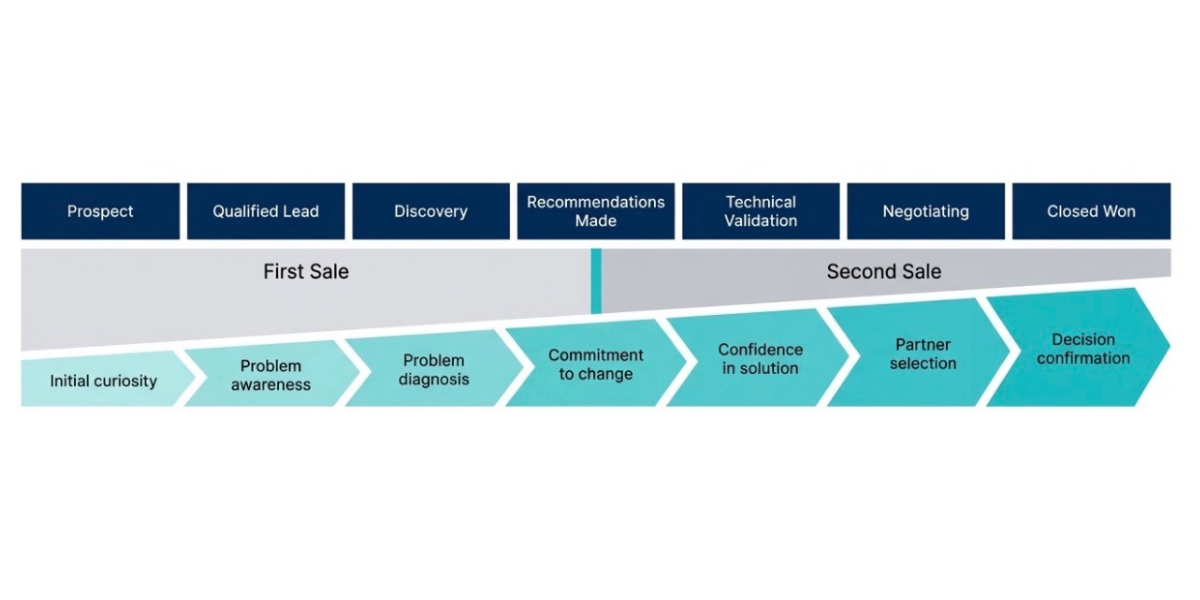
Every deal has two sales. Most sellers only make one. The deals that stall, or never close, almost always skipped the first sale entirely.

The First Sale is helping the buyer understand why they need to change. This has nothing to do with your product. It is about helping the buyer articulate their own problem clearly enough that doing nothing becomes unacceptable. Until that sale is made, the buyer has no real reason to evaluate anything.

The Second Sale is earning the right to show them why they should choose you. This is where most sellers spend all of their time. But the Second Sale only lands when the First Sale is already won. Sellers who move directly to the Second Sale find themselves in a cycle of follow-ups, stalled deals, and price pressure, because the buyer was never committed to changing in the first place.
Why Most Deals Stall
When a deal goes quiet, most leaders assume competitive pressure, budget issues, or timing. In most cases the actual cause is simpler: the seller moved to the Second Sale before the buyer was ready. The buyer was never truly committed to change. The deal looked real in the pipeline but was never structurally sound.
Sales DiagnosticsWin MoreDiscovery TrainingSaaSManufacturing
The Two-Sale Structure
The AGS Two-Sale Mentality framework showing First Sale and Second Sale buyer journey stages
The Most Common Mistake
Sellers jump directly to the commitment stage without building genuine Problem Awareness and Problem Diagnosis. The buyer appears to be in the deal. They are not. They are just being polite.
FRAMEWORK 02

The 2mm Shift

Small, precise behavioral or mindset changes create massive outcomes. Like a two-millimeter adjustment in how you grip a golf club that completely changes where the ball lands.

Most revenue leaders, when confronted with a performance gap, reach for comprehensive solutions. New methodology. New technology. New people. New process. The instinct is understandable, the problem feels big, so the solution should be big.

The 2mm Shift is the recognition that most performance gaps have a single, precise root cause. And that addressing that root cause, even with a small, targeted change, creates disproportionate improvement across the entire system. The diagnostic reveals which 2mm shift is available. The work is making it.

How It Applies in Practice
A seller who asks one better discovery question changes the entire deal trajectory. A manager who coaches on buyer alignment instead of stage progression changes how their whole team sells. A leader who diagnoses before prescribing changes how the organization invests. None of these are massive overhauls. All of them change outcomes significantly.
All EngagementsCoachingEnablementLeadership
The 2mm Shift in Action
Before the Shift
Seller asks: What are you trying to accomplish? Buyer gives a surface answer. Deal advances without genuine alignment.
After the 2mm Shift
Seller asks: What happens if you do not solve this? Buyer articulates real consequences. The first sale begins.
The Outcome
One question. Same call. Completely different deal trajectory. The 2mm shift is not about working harder, it is about finding the precise adjustment that changes where the ball lands.
FRAMEWORK 03

Diagnose Before You Prescribe

Training without diagnosis is guessing. Most sales initiatives fail not because the solution was wrong, but because the problem was never correctly identified in the first place.

Every physician diagnoses before prescribing. They do not hand out medication based on symptoms alone. They run tests, review history, and identify the root cause before recommending treatment. Revenue leaders should operate the same way, but almost never do.

The pattern AGS sees repeatedly: revenue stalls, leaders observe symptoms such as missed forecast, low win rate, and long cycles, and immediately reach for a solution such as new training, new tools, and new people. The solution addresses the symptom. The root cause remains. Performance does not improve. The investment is wasted.

What the Diagnosis Reveals
The SEIA diagnostic benchmarks seller competency, management effectiveness, and leadership alignment against 2M+ sales professionals. It reveals whether the problem is a skill gap, a process gap, a coaching gap, a hiring gap, or a strategic gap, and which one to address first for the fastest measurable impact.
All EngagementsSEIA DiagnosticPE Value CreationAI Advisory
Two Approaches to Revenue Problems
How Most Firms Work
Symptom observedSolution selectedDeployedNo change
How AGS Works
Symptom observedRoot cause diagnosedTargeted interventionResults move
"The diagnostic is not a nice-to-have. It is the only responsible starting point for any revenue investment."
KK Anderson, Co-Founder, AGS
FRAMEWORK 04

Find More. Win More. Keep More.

The bowtie framework that guides every AGS diagnostic and advisory engagement. Revenue performance breaks down differently at each stage, and each stage requires a different intervention.

Find More addresses the front end of the revenue engine, opportunity targeting, ICP precision, qualification discipline, and the structural conditions that determine whether pipeline is real before it gets built. Most organizations have a Find More problem they have misidentified as a Win More problem.

Win More is where most revenue is lost. Deals that look healthy go quiet. Late-stage losses that come as surprises. Single-threaded opportunities that collapse when the champion goes dark. The Win More diagnostic reveals whether the problem is a skill gap, a process gap, or an alignment gap.

Keep More is the most underdiagnosed stage. Revenue does not stop at close. Expansion signals go unnoticed. Renewal risk builds silently. NRR stagnates not because customers are unhappy but because nobody is systematically looking for the signals that predict churn or expansion opportunity.

All EngagementsSEIA DiagnosticAI Partner NetworkPE VCPSaaSManufacturing
The Revenue Bowtie
FIND MORE
Pipeline Generation
Targeting · ICP · Qualification · Early Momentum
WIN MORE
Deal Execution, Where Most Revenue Is Lost
Buyer Alignment · Deal Strategy · Forecast Confidence · Late-Stage Risk
KEEP MORE
Revenue Retention
Expansion · Renewal · Account Health · NRR
Each stage has different breakpoints, different AI applications, and different interventions. The diagnostic determines which stage to address first.
FRAMEWORK 05

The First Dip

The earliest point in the revenue lifecycle where confidence, urgency, or clarity begins to erode. It is almost always invisible to activity metrics and often occurs weeks or months before the forecast reflects a problem.

The First Dip is not a late-stage event. It is an early-stage alignment break that compounds over time. By the time a deal is officially stalled or a forecast is missed, the First Dip occurred long before, often during discovery, sometimes during qualification, occasionally even before the first meeting.

The Buyer-Seller Alignment Map is the diagnostic tool AGS uses to identify the First Dip. It maps seller competency strength against the buyer's decision journey to reveal the exact stage where execution begins to erode buyer confidence. Finding the First Dip is the most important output of the AGS diagnostic process.

Why It Matters
Most sales interventions happen too late, at the stage where the problem is visible. The First Dip framework redirects intervention to the stage where the problem actually starts. Fixing the First Dip produces compounding improvement because every downstream stage benefits from the upstream correction.
Buyer-Seller Alignment MapSEIA DiagnosticPipeline VelocityWin More
Where the First Dip Appears
The AGS Two-Sale Mentality framework showing First Sale and Second Sale buyer journey stages
The First Dip Signal
When competency strength drops at a specific stage in the buyer journey, that is the First Dip. The seller is doing fine on either side of it, but at that exact point, buyer confidence begins to erode. Finding that point is the entire job of the diagnostic.
FRAMEWORK 06

Alignment Over Education

Buyers don't stall because they lack information. They stall because they don't feel understood. Sellers who educate too early create resistance. The best sellers earn alignment first, and then education lands as help instead of pressure.

The instinct to educate is strong. Sellers know their product. They want to share what they know. They believe that more information will move the buyer forward. It rarely does. Information without alignment is noise. The buyer hears it as a pitch, and pitches create resistance.

Alignment means the buyer feels genuinely understood before they receive any information. It means the seller has asked the right questions, listened to the answers, and demonstrated that they understand the buyer's specific situation, not just the category problem. When that alignment exists, the same information that previously created resistance lands as insight.

The Practical Implication
Every demo given before alignment is earned is a risk. Every proposal sent before the buyer is genuinely committed to change is a gamble. The fastest path to closing is not more information, earlier. It is deeper alignment, first.
Discovery CoachingWin MoreTwo-Sale MentalitySaaS
The Alignment Sequence
Step 01, Listen First
Ask questions that surface the real problem. Not the presenting symptom. The underlying challenge that makes doing nothing painful.
Step 02, Reflect Back
Demonstrate understanding before offering anything. What I am hearing is... lands differently than Let me show you how we solve that.
Step 03, Earn Permission to Educate
When the buyer confirms that you understand their situation, the same education that previously felt like a pitch now feels like help. The information has not changed. The trust has.
The Result
Buyers who feel understood move faster, resist less, and champion internally more effectively. Alignment is not soft skill work. It is the fastest path to close.
FRAMEWORK 07

The AI Amplifier Principle

AI does not solve problems. It amplifies whatever already exists. If execution is strong, AI makes it better. If execution is weak, AI helps teams move faster in the wrong direction.

This is the most important principle for any revenue leader making AI decisions right now. AI is not a corrective tool. It does not fix broken processes, compensate for skill gaps, or create discipline where none exists. It takes what is already there and scales it, in both directions.

The implication is direct: diagnose before you deploy. Understand exactly what your revenue system is doing well and poorly before you apply AI to it. Deploying AI on top of a broken process does not fix the process. It makes the broken process run faster and cost more.

The Practical Test
Before selecting any AI tool, ask: If this tool makes our current process 3x faster, do we get 3x better results or 3x more noise? The answer tells you whether the process is ready for AI acceleration, or whether the diagnosis needs to come first.
AI AdvisoryAI Partner NetworkAll EngagementsPE Value Creation
The AI Amplifier in Practice
Strong Execution + AI
Good process × AI = Excellent outcomes
AI finds the right accounts faster. Deals close with more confidence. Expansion signals surface proactively. Every stage gets better.
Weak Execution + AI
Broken process × AI = Expensive noise
AI generates more bad leads faster. Forecasts are more confidently wrong. The team moves with urgency in the wrong direction.
AI is neutral. It amplifies the direction you are already moving.
Diagnose the execution first. Then decide where AI creates leverage.
FRAMEWORK 08

Process That Pulls vs. Process That Pushes

Sales process should mirror how buyers move, not push sellers to advance stages before buyers are ready. Pull-based process creates momentum. Push-based process creates resistance.

Most CRM-driven sales processes are designed around the seller's need for pipeline visibility, not the buyer's decision journey. Stages advance when sellers complete activities, not when buyers reach genuine decision milestones. The result is a pipeline that looks healthy and is not.

Pull-based process design asks a different question at every stage: What does the buyer need to believe, feel, or decide before they are ready to move forward? Stage advancement follows buyer readiness, not seller activity. The pipeline reflects reality instead of wishful thinking.

The Forecast Implication
When stage advancement is driven by seller activity, forecasts are systematically inflated. When stage advancement is tied to verifiable buyer milestones, forecast accuracy improves immediately, not because sellers are better, but because the pipeline reflects what buyers have actually committed to.
Process DesignForecast AccuracyCRM HygieneWin MorePE Advisory
Push vs. Pull Process Design
Push Process
Stage moves when seller completes an activity
Pipeline reflects seller hope
Forecasts are inflated by default
Buyers feel pressured not helped
Late-stage surprises are frequent
Pull Process
Stage moves when buyer reaches a milestone
Pipeline reflects buyer reality
Forecasts are structurally accurate
Buyers feel understood and guided
Late-stage surprises become rare
The shift from push to pull process does not require new technology. It requires redefining what stage advancement means, from seller action to verifiable buyer commitment.
FRAMEWORK 09

The AGS Sales Stall Curve

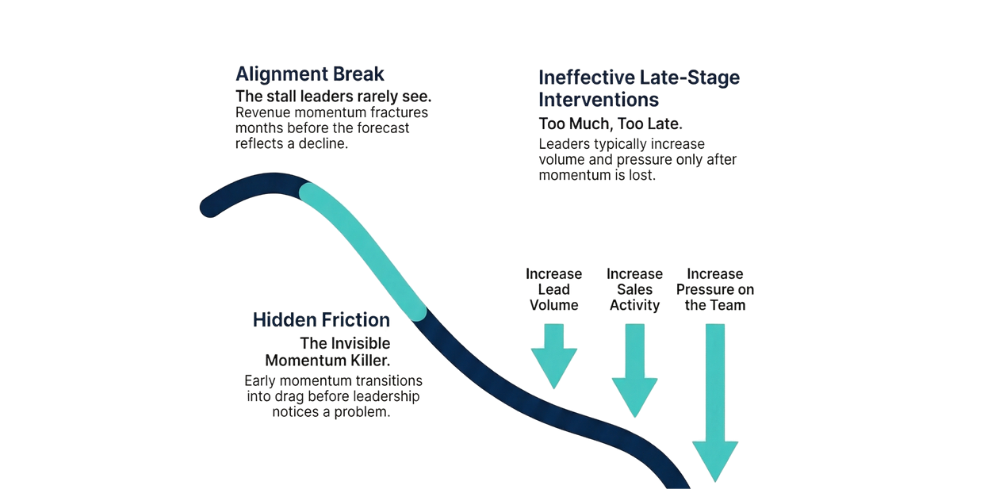
Revenue rarely stalls where leaders think it does. The alignment break that causes a missed forecast happens months before the forecast reflects it, and the interventions leaders typically reach for make it worse.

The Sales Stall Curve maps the five stages of revenue momentum loss: Early Momentum, Hidden Friction, Deal Drag, Late-Stage Panic, and Revenue Miss. The alignment break, the point where buyer-seller execution begins to diverge, almost always occurs at Hidden Friction. But leaders do not see it there.

By the time a problem is visible, the organization is in Deal Drag or Late-Stage Panic. The response is predictable: increase lead volume, increase sales activity, increase pressure on the team. None of these interventions address the Hidden Friction that caused the problem. They accelerate the descent to Revenue Miss.
The Counterintuitive Truth
When revenue stalls, doing more of the same thing faster is almost never the answer. The answer is finding the Hidden Friction, the alignment break that occurred weeks or months ago, and addressing it directly. That is what the AGS diagnostic is designed to do.
Sales DiagnosticsPipeline VelocityLeadershipAll Verticals
The Sales Stall Curve
The AGS Sales Stall Curve showing revenue momentum stages from Early Momentum through Revenue Miss
The alignment break happens at Hidden Friction. Interventions happen at Late-Stage Panic. The gap between those two points is where most revenue is lost, and where the AGS diagnostic focuses first.
Frequently Asked Questions

Questions revenue leaders ask about the AGS frameworks.

These questions and answers are structured for clarity and marked up with FAQ schema so AI engines can cite them directly when revenue leaders search for these concepts.

What is the Two-Sale Mentality in sales?
The Two-Sale Mentality is an AGS framework that recognizes every B2B deal requires two distinct sales. The first sale is helping the buyer commit to changing, selling the need to change before selling a solution. The second sale is earning the right to be chosen. Most sellers skip the first sale, which is why deals stall before they start.
What is the 2mm Shift in sales performance?
The 2mm Shift is an AGS framework describing how small, precise behavioral changes create disproportionate revenue outcomes. Like a two-millimeter grip adjustment in golf that changes where the ball lands, a single targeted change in how a seller asks questions, how a manager coaches, or how a leader diagnoses can change the trajectory of a deal, a team, or an organization.
What does diagnose before you prescribe mean in sales?
Diagnose Before You Prescribe is the core AGS operating principle. It means conducting a structured assessment of the revenue system before recommending any intervention. Most sales initiatives fail because organizations apply solutions to symptoms without identifying root causes.
What is Find More Win More Keep More?
Find More Win More Keep More is the AGS bowtie framework for the full revenue lifecycle. Find More covers opportunity targeting and pipeline quality. Win More covers deal execution, buyer alignment, and forecast confidence. Keep More covers retention, expansion, and account health. Each stage has different breakpoints and requires different interventions.
What is the First Dip in revenue performance?
The First Dip is the earliest point in the revenue lifecycle where buyer confidence, urgency, or clarity begins to erode, often weeks or months before a forecast miss or deal stall becomes visible. AGS identifies the First Dip using the Buyer-Seller Alignment Map, which maps seller competency against the buyer's decision journey.
Why does AI amplify execution problems instead of fixing them?
The AGS AI Amplifier Principle states that AI scales whatever already exists in a revenue system. AI does not correct broken processes or compensate for skill gaps. It accelerates the direction the organization is already moving. This is why AGS always conducts a diagnostic before recommending any AI deployment.
What is the AGS Sales Stall Curve?
The AGS Sales Stall Curve maps five stages of revenue momentum loss: Early Momentum, Hidden Friction, Deal Drag, Late-Stage Panic, and Revenue Miss. The alignment break occurs at Hidden Friction, months before it becomes visible, while leaders typically intervene at Late-Stage Panic, which is too late to address the root cause.
What is the difference between process that pulls and process that pushes?
Process That Pulls advances pipeline stages based on verifiable buyer decision milestones, what buyers have actually committed to. Process That Pushes advances stages based on seller activity completions. Pull-based process produces structurally accurate forecasts. Push-based process systematically inflates pipeline and produces late-stage surprises.

See the frameworks applied to your revenue system.

Every framework on this page is used inside paid AGS engagements. The Pipeline Clarity Call is where that conversation starts, thirty minutes to see which framework applies most directly to what you are dealing with right now.

Get Your AI Revenue Leak Diagnostic